Gold price and demand: A metric of global anxiety and fear, not greed
.png)

Gold hit a price of $4,000 per ounce in October 2025. Price of gold is naturally expected to gain and holds its value historically, however the price hitting $4,000 per ounce staggering because it had increased over 50% in a matter of a year alone. Is this surge a bubble waiting to burst or are there rational factors affecting this surge?
This surge in price many investors and fund managers in shock as such an occurrence naturally pulled funds away from traditional investments towards gold seen like never before. Naturally, the question may arise: Is this another irrational speculative bubble bound to burst? Historically, in post gold standard era, gold’s price has had an upward trend in times of uncertainty, kind of like a flight to safety. Given the state of the world currently with a cocktail of national and geopolitical instability, economic uncertainty and a never before seen realignment of global financial powers, this may not be an irrational decision after all.
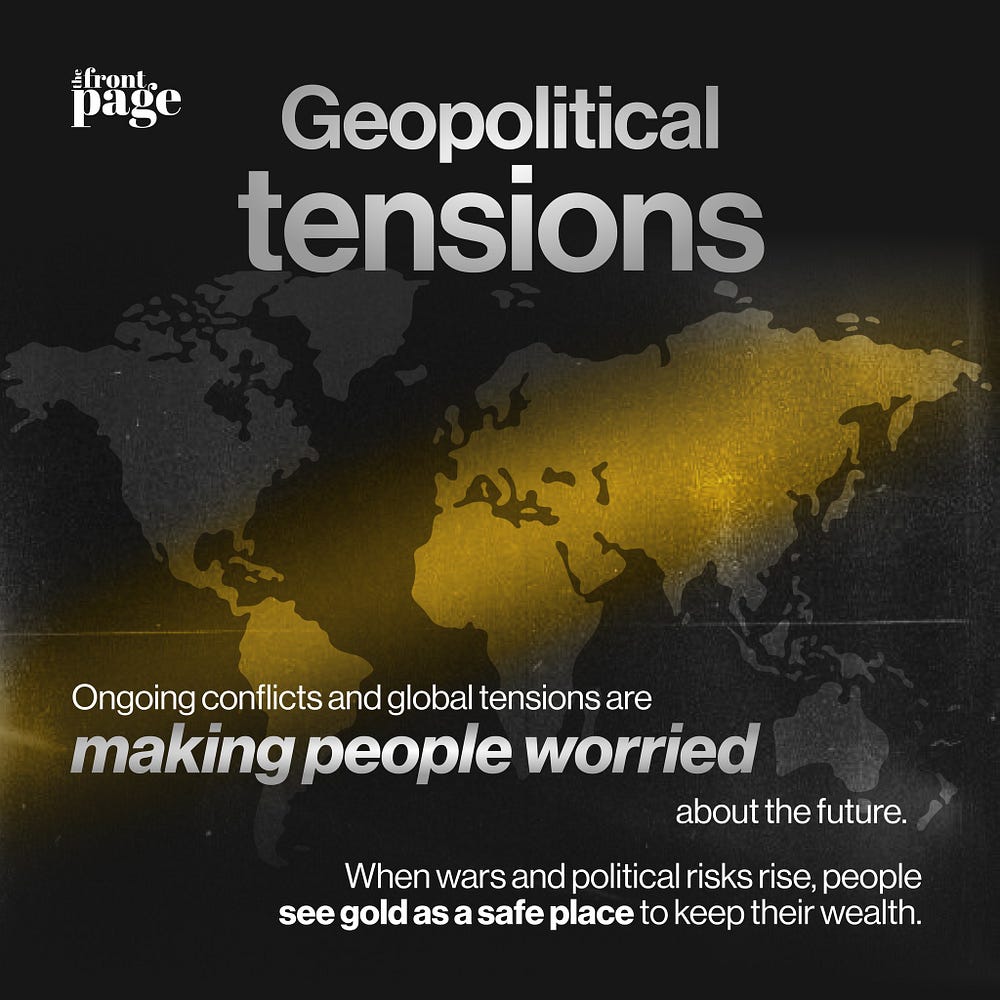
At the core of gold’s renewed surge in demand is it’s historic status as an ultimate safe haven asset in times of geopolitical turmoil. Globally, nations are navigating a minefield of geopolitical instability. The long drawn out war between Ukraine and Russia, continuous tensions between China and Taiwan, major volatility in the Middle East have instilled a deep sense of uncertainty into the international financial markets. For individual and institutional investors, these conflicts represent significant risk to traditional financial instruments, which are deeply integrated to the global world order stability. In such environments, gold stands out as an indispensable stable asset without much alternatives which are as stable as it has been historically being a reliable store of value dating back to thousands of years.
This flight of wealth towards safety is aggravated by a widespread fear and economic anxiety. Major economies are struggling with stubbornly high rate of inflation and even higher interest rates which results in eroding purchasing power of fiat currencies and slowing down economic growth. There are alarm bells ringing over the concerns of the financial health of the US economy which is the bedrock and anchor of the global financial system. Rising debt, a weak job market, rising unemployment, risk of US government shutdowns have all dented the confidence in the leading economy. All of this has affected the global economy to varying degrees. As a result of all these factors, it has hit a very critical aspect of global trade: The U.S. Dollar, which is the globally accepted medium of exchange and coined as the world’s reserve currency. This has made gold relatively cheaper for holders of other currencies which has further stimulated the global demand for gold. As the dollar’s credibility to hold it’s value gets more questioned, the attraction of a non-state controlled and tangible asset like gold keeps growing exponentially.

While individual gold demand is surging, the main driver of this demand has been by central banks worldwide as they raced to buy more gold. Central banks across the world have coordinated and consciously moved away from storing USD currency as their reserve currency towards slowly acquiring more gold.
Over the last decade, central banks have been adding 500 tonnes of gold to their reserves annually (on average globally), this has increased to 1,000 tonnes annually past few years. While on the face of it, may look like a diversification strategy, it may also be a form of panic buy and loss of trust in the USD. This is further backed up by the fact that nations are actively reducing their reliance on a single currency for their reserves and it appears that (for now) they have hedged their confidence in gold. Going a step further, some nations such as India for example have decided to repatriate their physical gold held in overseas vaults further backs up this monetary trend towards financial sovereignty and renewing faith in gold as a reserve asset over fiat currencies.
The factors propelling gold’s demand and price show no signs of slowing down. Most major financial analyst institutions are in agreement that this bullish trend shall continue and even any minor or major global instability may shoot up the demand and prices even further than anticipated in the near future. Another major factor in the future may be potential for U.S. Federal Reserve cutting interest rates to stimulate a stagnant economy. This would result in additional pressure on the dollar which may fuel the demand and price of gold even more.
To conclude, the ongoing rush for gold is more than just a temporary market trend, rather it is an indicator of global affairs currently reflecting anxiety regarding geopolitical stability and the future global economy. In my view, these record breaking demand and prices are not irrational, but rather a logical response by investors and nations seeking a reliable financial asset anchor in a world of turbulent cross‑currents
So as long as geopolitical and regional uncertainty persists, so as long as the global financial markets do not recover, the demand and price of gold shall continue to rise, not just as a commodity alone but as a hedge and metric of global risk assumptions.
Written by
Shafqat Aziz
Barrister (of Lincoln’s Inn)
LLM Corporate Law, NTU
PGDL, UWE Bristol
LLB, BPP University
Accredited Civil-Commercial Mediator (ADR-ODR International)
Comments
Post a Comment